SDC Verifier 2026 R2
New Standards, Multiaxial Fatigue, and 3D View
SDC Verifier 2026 R2 expands the workflow from finite element analysis (FEA) results and engineering standard verification to the review of critical results and preparation of calculation reports. The update focuses particularly on new standard support for offshore and marine applications, multiaxial fatigue assessment in accordance with DNV-RP-C203, improvements to tubular connection checks, and the new 3D View feature for SDC for Ansys.
New Standards and Expanded Code Coverage
One of the most important aspects of the 2026 R2 release is the expansion of the standards library, particularly for offshore, marine, lifting equipment, and structural steel applications.
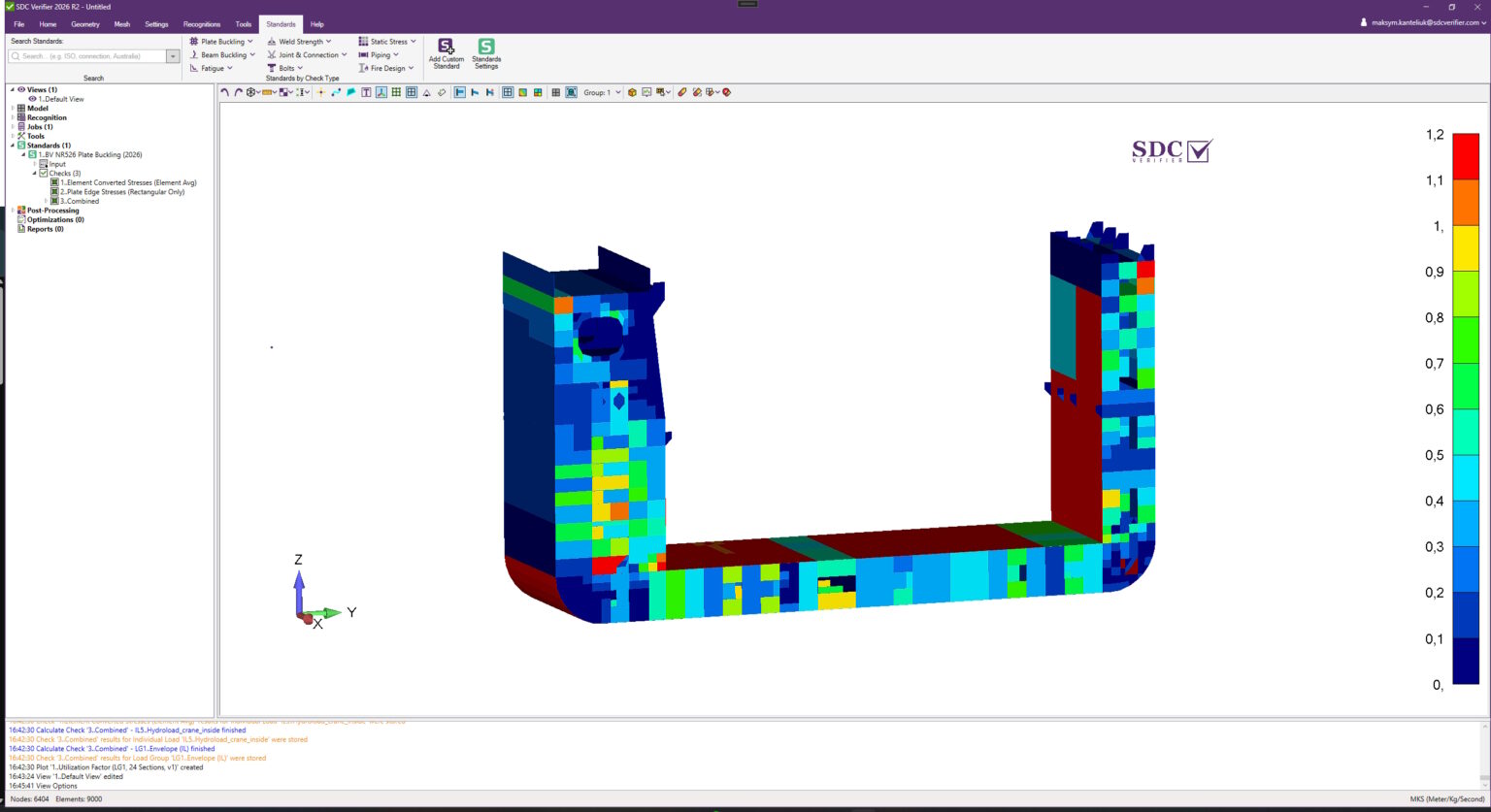
SDC Verifier can now perform plate buckling verification of lifting equipment used on ships and offshore units in accordance with Bureau Veritas NR526, January 2026, Part 2, Appendix 4. The check is performed using sections and plates recognized from the FE model. Panel Finder can automatically determine panel geometry and dimensions, while material properties, plate thickness, stresses, and safety factors are used directly in the verification.
The engineer can choose whether stresses are taken from plate edges, plate averages, or at element level. Stress transformation into the required plate directions is performed automatically. Curved plates are excluded from this check to prevent them from being incorrectly assessed using the flat-panel methodology.
Figure: The source blog includes the BV NR526 plate buckling verification interface/result view.
- API RP 2A-LRFD Connections (2019)
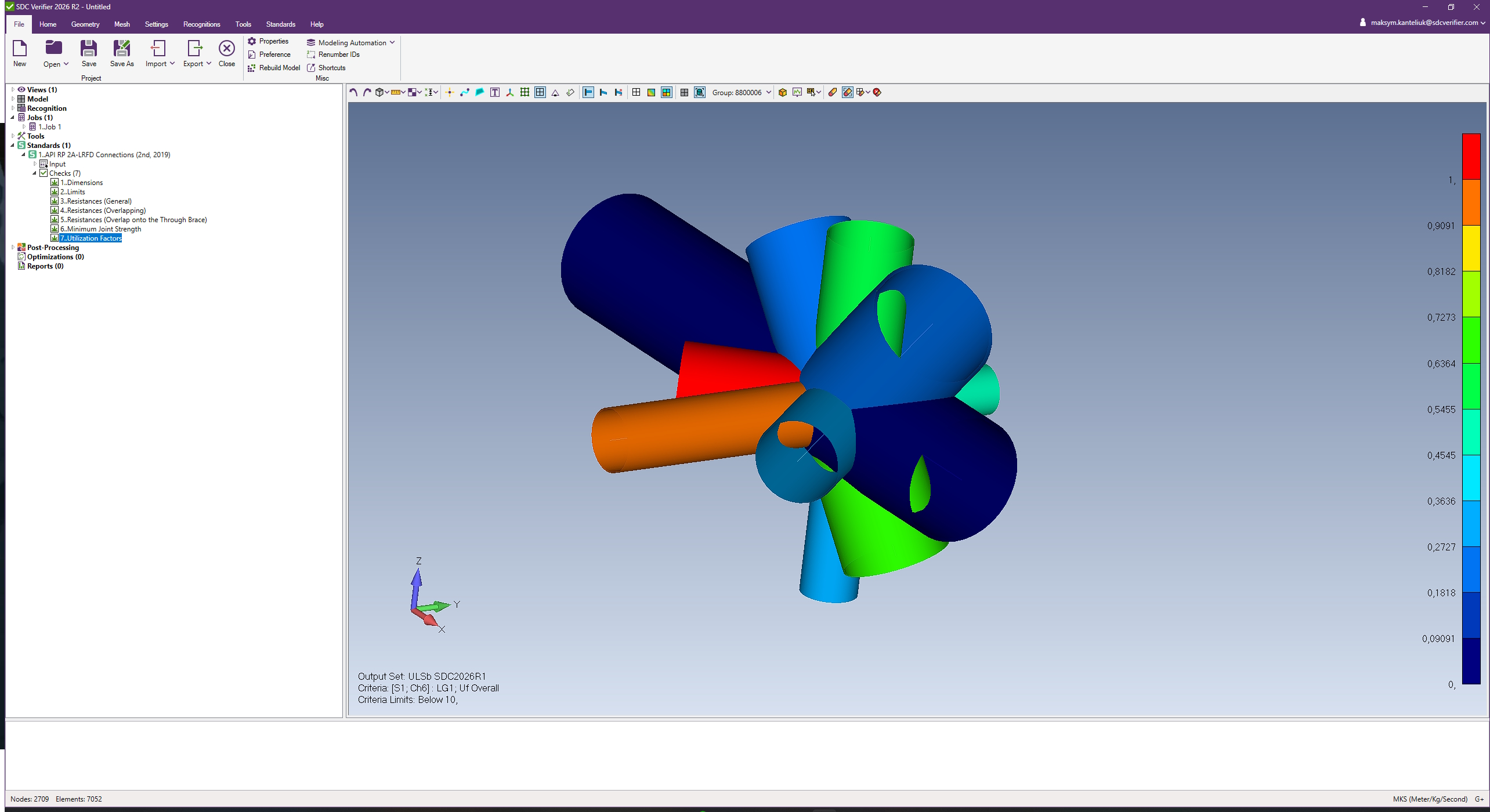
The new API implementation supports tubular connection verification in accordance with API RP 2A-LRFD, 2nd Edition, November 2019, Section 14. Chord and brace geometries recognized by Connection Finder are used. Brace classification allows the member to be treated as K, TY, or Cross behavior in the connection strength calculation. Effective brace lengths, chord can information, axial forces, bending moments, and material properties can be included in the calculation.
Figure: SDC Verifier screen for API RP 2A-LRFD tubular connection verification.
- ISO 19902 Connections (2020)
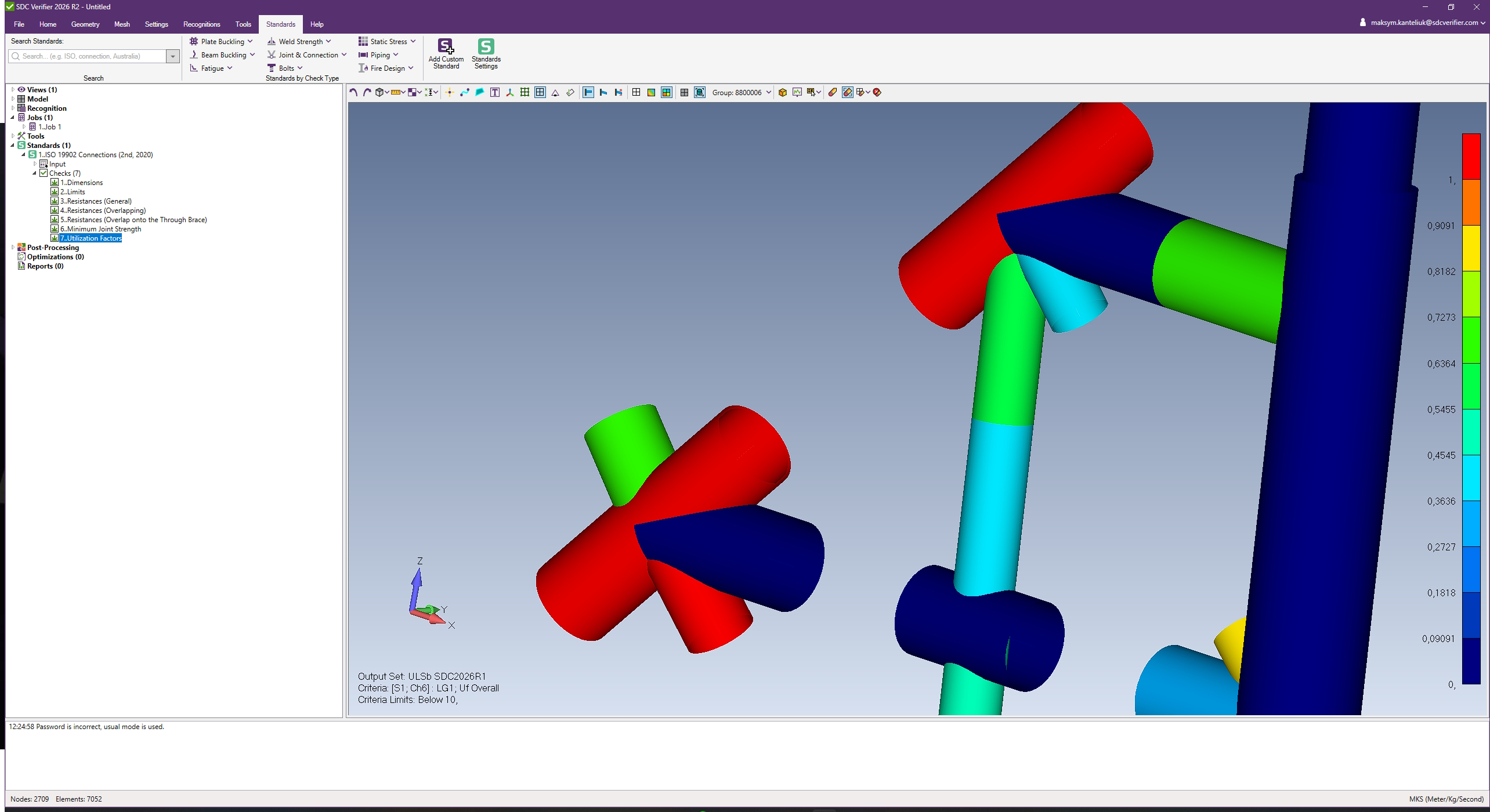
Tubular joint strength assessment in accordance with ISO 19902:2020, Section 14 has also been added in 2026 R2. Defined connection geometry, brace classification, material properties, and forces obtained from the model are used. Chord-force effects, chord cans, critical connections, and overlapped joint conditions are also covered.
Figure: Software screen related to ISO 19902 tubular joint verification.
- AS 4100 Members (2020)
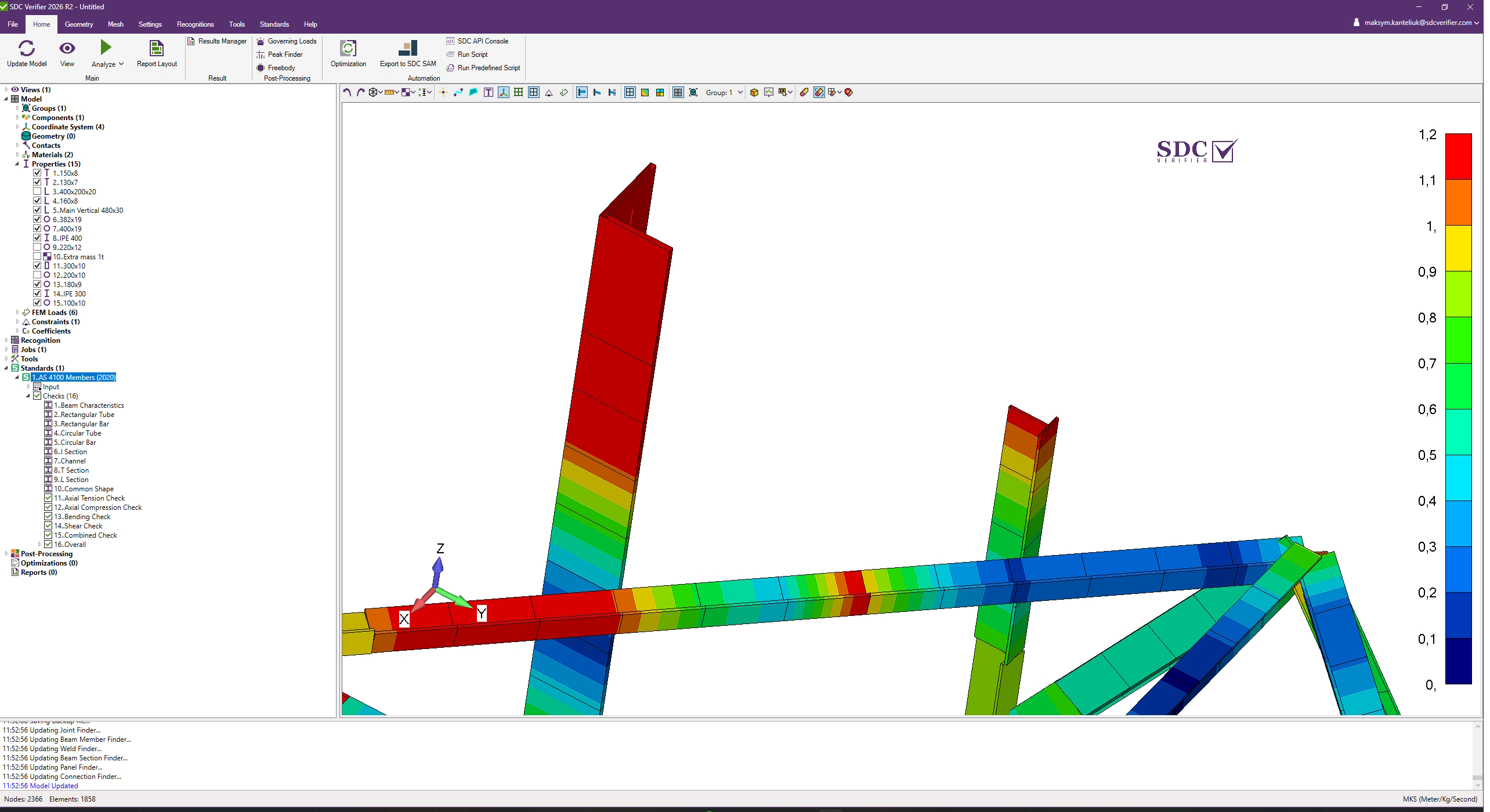
The existing AS 4100 Members implementation has been expanded to cover T-sections and equal-leg angles. Tension, compression, bending, shear, and combined effects can now be checked for a wider range of steel member geometries. Beam Member Finder provides member lengths, while standard-specific parameters such as residual stresses, lateral restraints, moment modification factors, section constants, and capacity factors can be configured by the user.
- Aynı Modelde Düz ve Eğrisel Plaka Burkulması
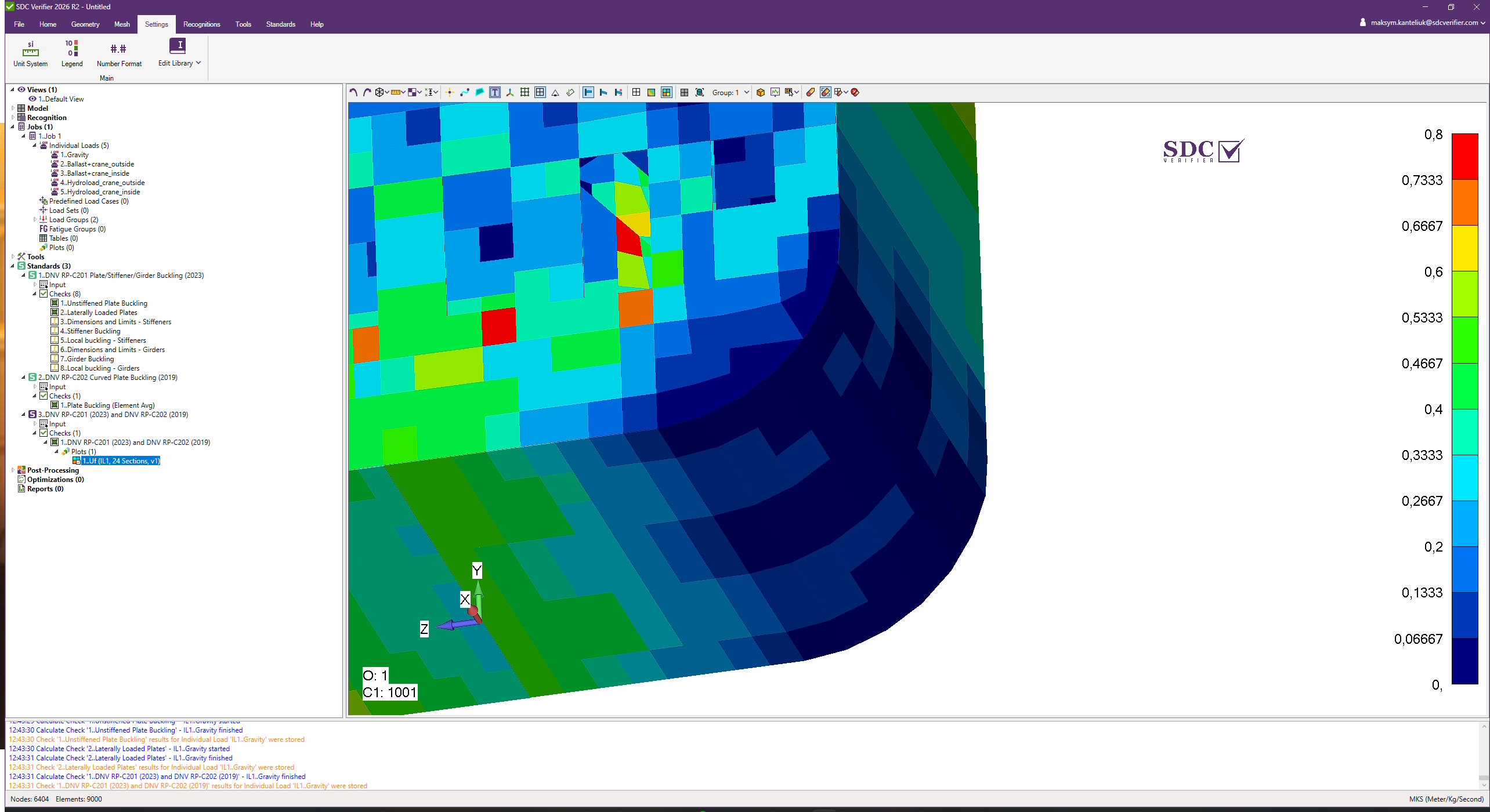
When flat and curved plates exist in the same model, DNV-RP-C201 Plate/Stiffener/Girder Buckling (2023) and DNV-RP-C202 Curved Plate Buckling (2019) can be used together. This allows the appropriate buckling methodology to be applied to each plate type within the same verification workflow instead of forcing different geometries into a single calculation approach.
DNV
-RP-C203'e Göre Çok Eksenli Yorulma
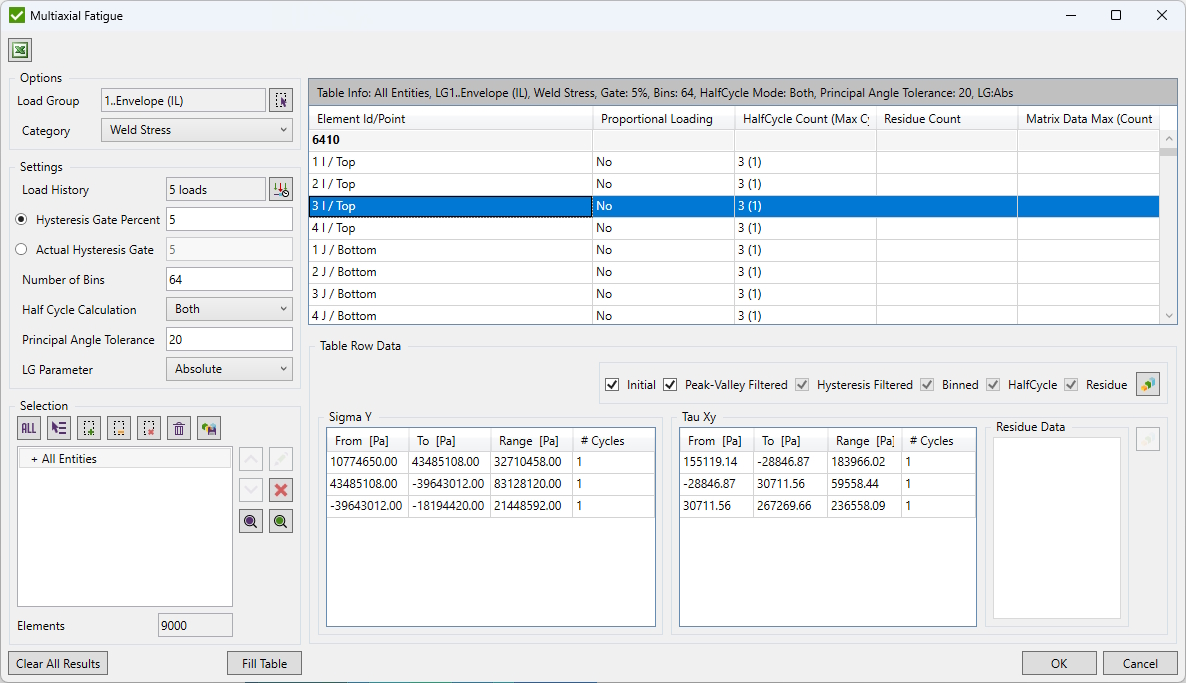
One of the most important engineering additions in the release is the Multiaxial Fatigue Tool. The tool prepares the stress-history data required for multiaxial fatigue assessment in accordance with DNV-RP-C203 Fatigue (October 2024), Section 5.6.
Under proportional loading, the principal stress direction remains largely constant and rainflow counting can be applied to the relevant directional stress channels. Under non-proportional loading, normal and shear stresses may vary independently throughout the load history and the principal stress direction may rotate. In this case, applying independent rainflow counting to the stress components can cause the physical phase relationship to be lost.
SDC Verifier uses a master–slave approach for this situation. The normal stress perpendicular to the weld toe is treated as the master series, while shear-stress ranges over the same time intervals are determined accordingly. This keeps the normal and shear components associated within the same physical load cycle.
The user can configure the load history, hysteresis filtering settings, number of bins, half-cycle calculation, principal-angle tolerance, nested load-group behavior, and the portion of the model to be processed.
Figure: Multiaxial Fatigue Tool and stress-history processing screen.
Improvements in Brace and Tubular Connection Verification
Brace Stress Tool now calculates both elastic and plastic buckling stresses. Supported ISO, API, and NORSOK connection standards can also use plastic buckling stresses. The tool calculates axial, in-plane bending, and out-of-plane bending stresses from connection forces and properties such as cross-sectional area and section moduli.
This approach strengthens the assessment of a tubular connection not only in terms of joint geometry but also together with the capacity and buckling behavior of the connected brace. Handling of overlap conditions in Joint Check tables has also been improved.
New 3D View for SDC for Ansys
2026 R2 introduces the first version of the new 3D View feature in SDC for Ansys as BETA. This view is intended to improve performance and visualization, particularly when reviewing load and verification results using SDC Criteria Plots and Contour Plots.
In large and complex models, engineers need to move quickly between the overall structure, critical regions, individual checks, and the FE results behind them. The new 3D View provides a more fluid result-review environment within the Ansys workflow. In addition, SDC for Ansys can generate certain SDC plots even when no solved solution is available in Mechanical.
Figure: Screenshot of the new 3D View in SDC for Ansys.
Recognition, Reporting, and Daily Workflows
Improved Standards Tab
As the standards library grows, finding the correct check can become more difficult. Therefore, the Standards tab on the ribbon has been redesigned. Standards are organized by check type and can be searched using parameters such as name, industry, year, country, and verification type.
Recognition Information in Report Designer
Recognition information generated by Beam Section Finder, Connection Finder, and Joint Finder can now be used in Report Designer. This shortens the transition between recognizing structural objects in the FE model, verifying them, and documenting them in the calculation report. Panel Finder has also been expanded to support predefined girders modeled with plate elements.
Weld Finder Improvements
Renaming multiple welds, selection operations, and sorting have been improved. Weld and Weld Parts tables have been reorganized to display more relevant information. Such improvements become especially important in large models containing hundreds or thousands of recognized structural objects.
More Repeatable Result Visualization
Peak Finder can now use saved Views. Peak results can be reviewed while preserving camera position, model style, and other display settings. Views selected with Apply to Selected can also be used for Model Plots in Report Designer, improving visual consistency between engineering review and the final report.
Compatibility, Performance, and Usability
- Support for Femap 2606 and Simcenter 3D 2606.
- Synchronization of engineer information from the user account when creating a project.
- Addition of Undo and Redo to the toolbar.
- Optional automatic launch of SDC Verifier after installation.
- Changes to background logging behavior to improve responsiveness while other windows are open.
- Effective Plate Width Tool now follows the selected display unit system.
- Simplified display of plate and section thickness.
- Improved performance when generating Expand Tables for fatigue checks.
- No-Solver license module for standalone SDC Verifier.
Calculation Accuracy and Stability
In addition to new features, R2 includes corrections to calculations and result processing. Fixes have been made for Eurocode 3 Members, API RP 2A-WSD pile calculations, API RP 2A-LRFD connection calculations, Hot Spot Stress for solid elements, and Ansys/Simcenter 3D result-reading scenarios.
Corrections have also been made in recognition-related areas such as Connection Finder, Panel Finder, Joint Finder, brace gaps, duplicate elements, and coordinate-system determination in Weld Summation Tool. Various stability and usability issues involving crashes, autosave, Save As, Report Designer, and visibility have also been addressed.
Practical Impact of 2026 R2
SDC Verifier 2026 R2 aims to address more engineering problems within the same verification environment and reduce manual transitions between model data, code calculations, result review, and reporting. Offshore and marine engineers gain broader plate buckling and tubular connection standard coverage; fatigue analyses gain multiaxial loading support according to DNV-RP-C203; and SDC for Ansys users gain a new 3D result-review environment.
The overall approach is to use the structural model and analysis results as the basis for verification, automatically recognize critical engineering objects, apply the required design-code checks, identify governing results, and transfer the same information into a traceable calculation report without rebuilding it in different tools.
Short Technical Summary
| Area | 2026 R2 Enhancement | Engineering Impact |
| Plate Buckling | BV NR526 (2026) | New verification route for marine/offshore lifting equipment |
| Tubular Connections | API RP 2A-LRFD + ISO 19902 | Model-based verification of connection geometry and brace effects |
| Steel Members | Expanded AS 4100 coverage | Verification of a wider range of section geometries |
| Fatigue | DNV-RP-C203 Multiaxial Fatigue | Processing of proportional and non-proportional multiaxial load histories |
| Ansys | New 3D View (BETA) | More fluid result review for large models |
| Reporting | Recognition data + Views | More traceable transfer from model verification to reporting |
| Performance | Compatibility and speed improvements | Reduced friction in daily engineering workflows |